
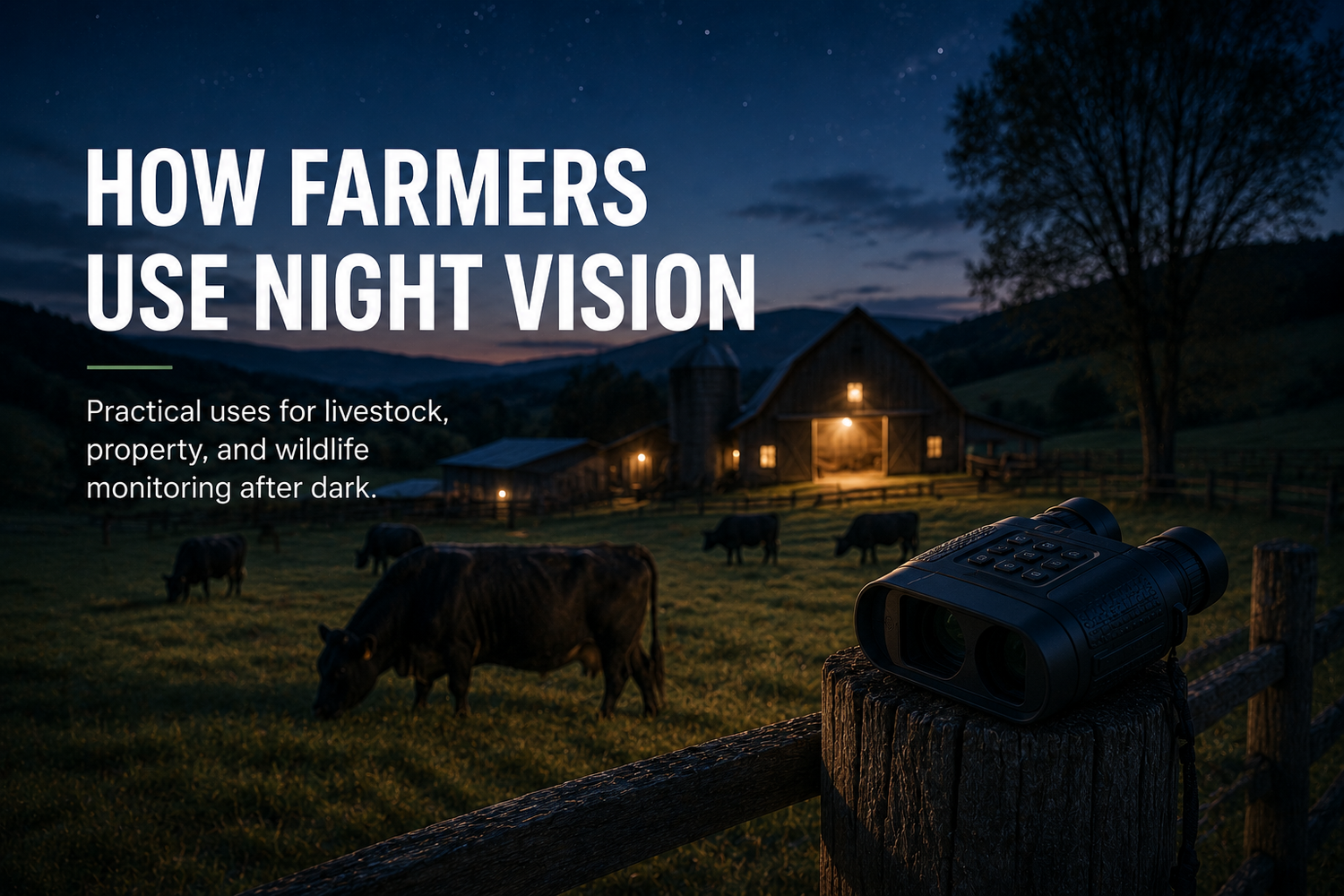
How Farmers Use Night Vision
- Farms rarely stop operating when the sun goes down.
- Livestock may remain active, wildlife can enter fields, gates may be left open, and unusual sounds can come from barns, fences, or remote sections of the property. Walking into a dark field with only a flashlight is not always the safest or most effective way to investigate.
- Digital night vision gives farmers a practical way to observe dark areas from a distance. It can help users check livestock, inspect property boundaries, watch for wildlife, and record nighttime activity without flooding the area with bright visible light.
- This guide explains how farmers use night vision, where it can be most useful, and which features matter when choosing a device for rural property.
Why Nighttime Visibility Matters on a Farm
Farm environments often include large open spaces, wooded boundaries, barns, sheds, fencing, equipment, and animals spread across different areas.
At night, visibility can be limited by:
- Distance between buildings and fields
- Uneven ground
- Trees and vegetation
- Limited outdoor lighting
- Weather conditions
- Moving animals
- Remote gates or fence lines
A visible flashlight can help at close range, but it may also create glare, reduce your natural night vision, and disturb animals.
Night vision allows users to observe a wider area before deciding whether they need to walk closer.
It does not replace proper lighting, security cameras, fencing, or routine inspections. However, it can become a useful observation tool for nighttime checks.
1. Monitoring Livestock After Dark
One of the most practical uses of night vision on a farm is checking livestock without immediately entering a field, pen, or barn.
Farmers may use night vision to observe:
- Cattle
- Horses
- Sheep
- Goats
- Pigs
- Poultry
- Alpacas
- Other farm animals
From a safe position, a user may be able to confirm whether animals are:
- Resting normally
- Moving as expected
- Gathered near a gate
- Separated from the group
- Reacting to a disturbance
- Near damaged fencing
- Showing unusual nighttime behavior
This can be especially useful when a noise, alert, or sudden movement needs to be investigated.
Night vision cannot diagnose illness or injury. Any animal that appears distressed should still be checked directly and handled according to appropriate veterinary and farm procedures.
Less Disturbance During Routine Checks
Bright lights can startle livestock, affect their movement, or disrupt resting animals.
Digital night vision allows farmers to check an area with less visible illumination. In some low-light conditions, a device may use available moonlight or distant ambient light. In complete darkness, an infrared illuminator can provide additional visibility.
This may make night checks calmer and more controlled.
For livestock monitoring, useful features include:
- Adjustable infrared brightness
- Clear low-light imaging
- Comfortable viewing
- Simple controls
- Stable handheld performance
- Photo and video recording
2. Checking Fences, Gates, and Property Boundaries
Fence damage can create serious problems, especially when animals are near roads, neighboring properties, wooded areas, or crop fields.
Night vision can help farmers scan:
- Fence lines
- Gates
- Corrals
- Pasture entrances
- Driveways
- Tree lines
- Field edges
- Access roads
From a distance, users may be able to detect movement, identify open areas, or notice animals gathered near a possible weak point.
A tripod can be helpful when observing a fixed boundary for an extended period. It reduces image shake and makes it easier to study one area.
Night vision is most useful as an early observation tool. It should not replace a physical fence inspection when damage is suspected.
3. Observing Wildlife Near Livestock and Crops
Many farms are surrounded by natural wildlife habitat.
Depending on the region, nighttime visitors may include:
- Deer
- Coyotes
- Foxes
- Raccoons
- Wild hogs
- Rabbits
- Owls
- Rodents
- Stray dogs
- Other nocturnal animals
Night vision can help farmers determine what is moving near a pasture, barn, feed area, orchard, or crop field.
This is useful because not every nighttime sound requires the same response. A deer crossing a field is different from an unknown animal repeatedly approaching livestock or feed storage.
Recording capability can also help document recurring activity and compare patterns over time.
When observing wildlife, users should follow local regulations and avoid disturbing, approaching, feeding, or handling wild animals.
4. Inspecting Barns, Sheds, and Storage Areas
Barns and farm buildings can contain dark corners, narrow aisles, stored equipment, feed, tools, and animals.
Digital night vision may help users inspect these spaces before entering.
Possible uses include checking:
- Barn entrances
- Feed storage areas
- Machinery sheds
- Poultry houses
- Equipment yards
- Hay storage
- Remote outbuildings
- Loading areas
Night vision can help identify movement or confirm whether an area appears clear.
However, it should not be treated as a substitute for safe lighting. Farmers should still use proper illumination when walking, operating equipment, handling animals, or entering hazardous areas.
5. Watching Calving, Foaling, and Other Animal Activity
During calving, lambing, kidding, or foaling seasons, farmers may need to check animals more frequently at night.
Night vision can help users observe from a distance before deciding whether closer attention is necessary.
It may help confirm whether an animal is:
- Resting
- Standing
- Moving away from the group
- Showing increased activity
- Remaining in one area
- Interacting with a newborn
This can reduce unnecessary disturbance during routine observation.
Night vision should never replace direct monitoring, experienced judgment, veterinary guidance, or appropriate animal-care procedures during birth or medical emergencies.
6. Monitoring Farm Equipment and Work Areas
Equipment, fuel storage, trailers, and tools may be located away from the main house or farmhouse.
Night vision can help users scan:
- Parked tractors
- Utility vehicles
- Trailers
- Fuel tanks
- Workshops
- Storage yards
- Equipment entrances
- Remote work areas
For property awareness, photo and video recording can be useful. It allows users to save footage of unusual activity.
Night vision binoculars are not a complete farm security system. For continuous monitoring, fixed security cameras, motion lights, alarms, secure locks, and controlled access are usually more appropriate.
Night vision is best used as a portable observation tool that supports those systems.
7. Checking Fields and Crops at Night
Some crop activity becomes more noticeable after dark.
Farmers may use night vision to observe:
- Wildlife moving through fields
- Animals feeding near crops
- Activity around orchards
- Movement near irrigation equipment
- Field entrances
- Remote access points
- Activity along hedgerows
Because night vision can cover more distance than a standard handheld flashlight, it may help users scan a broad area before walking into the field.
Actual visibility will depend on the device, terrain, vegetation, ambient light, weather, infrared strength, and subject size.
8. Inspecting Remote Areas More Safely
Rural properties can include ditches, wooded trails, ponds, uneven ground, drainage areas, and isolated structures.
Before approaching a dark area, farmers can use night vision to look for:
- Animals
- People
- Vehicles
- Open gates
- Fallen branches
- Movement near water
- Obstacles along a path
This can improve situational awareness, but it does not make walking in darkness risk-free.
When moving around a farm at night, users should still carry appropriate lighting, wear suitable footwear, avoid unsafe terrain, and follow normal farm safety procedures.
A practical farm setup may use both.
Security cameras can monitor important locations continuously, while handheld night vision can help investigate areas beyond camera coverage.
What Features Should Farmers Look For?
Not every night vision device is equally suitable for farm use.
The following features are especially important.
Clear Low-Light Image Quality
Image quality should be good enough to distinguish animals, structures, movement, and boundaries.
Do not judge a device only by its advertised recording resolution. Sensor quality, lens performance, image processing, focus, and infrared illumination all influence the final image.
Real nighttime sample footage is often more useful than specification numbers alone.
Adjustable Infrared Illumination
Infrared illumination helps the device work in very dark or completely dark conditions.
Adjustable IR levels are useful because different situations require different amounts of illumination.
A lower IR level may be enough inside a barn, while a higher level may be needed for an open field.
Too much infrared light at close range can cause overexposure, so adjustment is important.
Practical Viewing Range
Manufacturers may advertise a maximum range, but users should understand the difference between detection and identification.
- Detection: You can see that something is present.
- Recognition: You can tell whether it is generally an animal, person, or vehicle.
- Identification: You can determine more clearly what the subject is.
Identification range is usually shorter than detection range.
For farm use, real-world subject recognition is more important than the largest range number on the package.
Comfortable Display
Farmers may need to observe an area for several minutes.
Look for:
- Adjustable screen brightness
- Comfortable eyecups
- Diopter adjustment
- Clear menu icons
- Suitable eye relief
- Easy focus controls
A bright display can be uncomfortable at night, so brightness adjustment is valuable.
Photo and Video Recording
Recording can be helpful for:
- Documenting wildlife activity
- Reviewing unusual behavior
- Tracking repeated visits
- Saving livestock observations
- Recording property activity
Check whether the device supports:
- Photo capture
- Video recording
- Audio
- Time and date stamps
- MicroSD storage
- Easy file transfer
For high-resolution recording, use a compatible memory card with an appropriate speed rating.
Long Battery Life
Nighttime farm checks may last longer than expected.
Battery life can be affected by:
- Infrared brightness
- Display brightness
- Recording
- Cold temperatures
- Wireless functions
- Battery condition
USB-C charging and power bank compatibility can be useful for extended use.
A device with strong daytime runtime may operate for less time when the IR illuminator is running continuously.
Weather Resistance
Farm devices may be exposed to:
- Dust
- Light rain
- Humidity
- Cold
- Mud
- Condensation
Look for a clearly stated IP rating where available.
Weather resistance does not necessarily mean the device can be submerged or left outdoors. Port covers should remain closed, and the device should be cleaned and dried after use.
Tripod Compatibility
A tripod can improve viewing comfort when watching:
- A pasture
- A gate
- A barn entrance
- A field edge
- A wildlife route
- A distant fence line
Stable mounting also improves recorded footage.
Simple Controls
Farmers may operate night vision while wearing gloves or standing in darkness.
Useful controls should be:
- Easy to locate by touch
- Clearly separated
- Quick to learn
- Simple to operate
- Accessible without opening complex menus
A practical control layout can matter more than having many rarely used features.
Choosing the Right Night Vision Style for Farm Use
Handheld Binocular-Style Night Vision
Best for:
- Livestock checks
- Field observation
- Boundary scanning
- Wildlife monitoring
- Recording photos and videos
Advantages:
- Suitable for tripod use
Night Vision Monocular
Best for:
- Quick checks
- Lightweight carrying
- Compact storage
- Short observation sessions
Advantages:
- Smaller size
- Lower weight
- Easy to carry in a bag or vehicle
Head-Mounted Night Vision
Best for:
- Hands-free observation
- Tasks that require both hands
- Helmet-compatible setups
Important limitation:
Head-mounted equipment requires careful fitting and may not be ideal for walking across uneven farm ground without additional visible lighting.
Night Vision Tips for Farmers
Head-Mounted Night Vision
Best for:
- Hands-free observation
- Tasks that require both hands
- Helmet-compatible setups
Important limitation:
Head-mounted equipment requires careful fitting and may not be ideal for walking across uneven farm ground without additional visible lighting.
Night Vision Tips for Farmers
To get better results:
-
Test the device before an emergency.
Learn the controls, focus, IR settings, and recording functions in advance. -
Start with a low IR level.
Increase brightness only when needed. -
Use a tripod for long observation.
This reduces shake and improves detail. -
Keep the lens clean.
Dust, fingerprints, and moisture can reduce clarity. -
Carry a flashlight.
Night vision is useful for observation, but visible light is still necessary for safe movement and close inspection. -
Check battery levels before leaving.
IR illumination can consume power quickly. -
Format the MicroSD card in the device.
This can reduce recording errors. -
Avoid pointing the IR illuminator through glass.
Infrared light may reflect back and cause glare. -
Review footage on a larger screen.
Details may be easier to see on a computer or tablet. -
Store the device in a dry case.
Protect it from moisture, dust, and impact.
See More Around the Farm After Dark
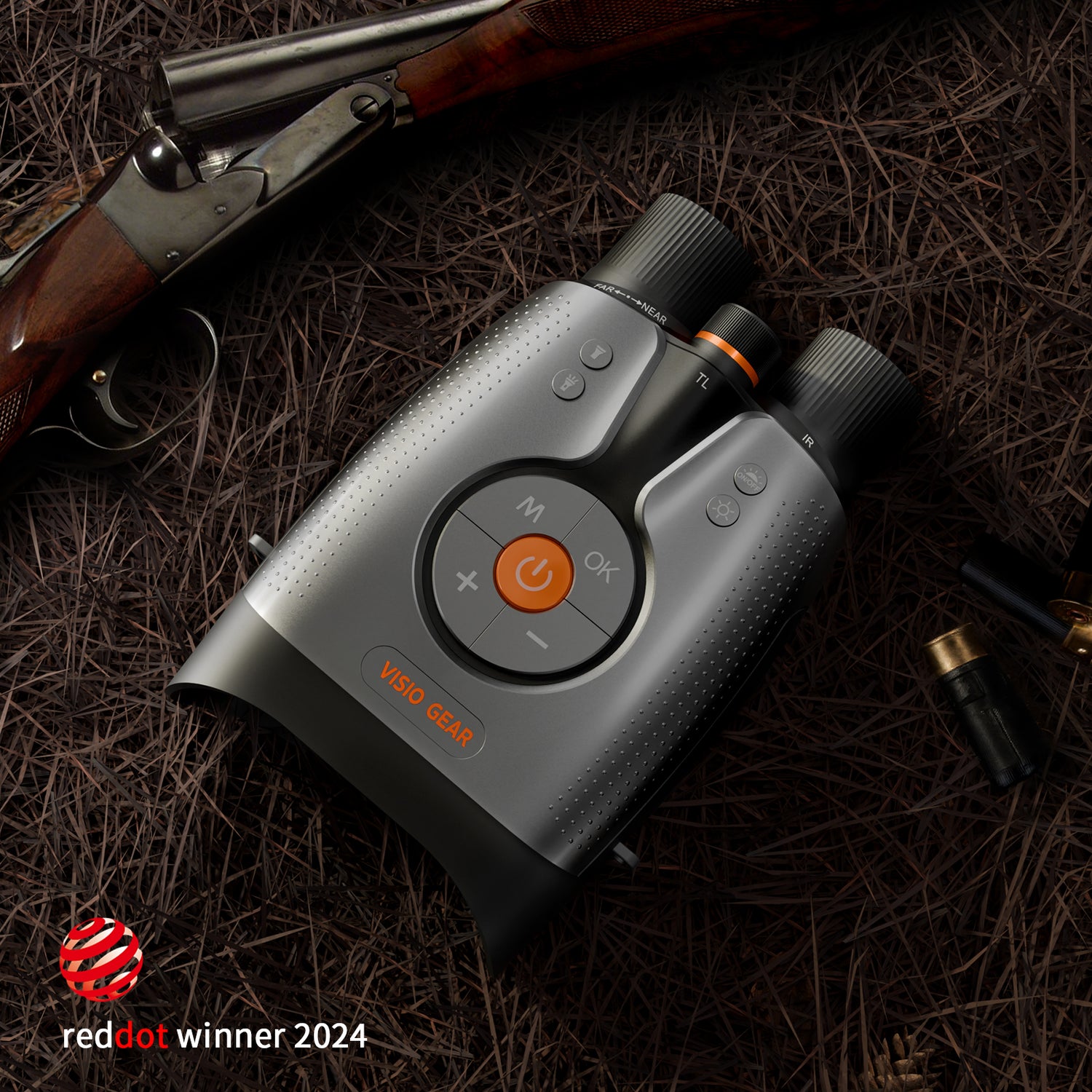
Explore VisioGear digital night vision devices for livestock monitoring, wildlife observation, property checks, and nighttime farm use.
0 commentaire